
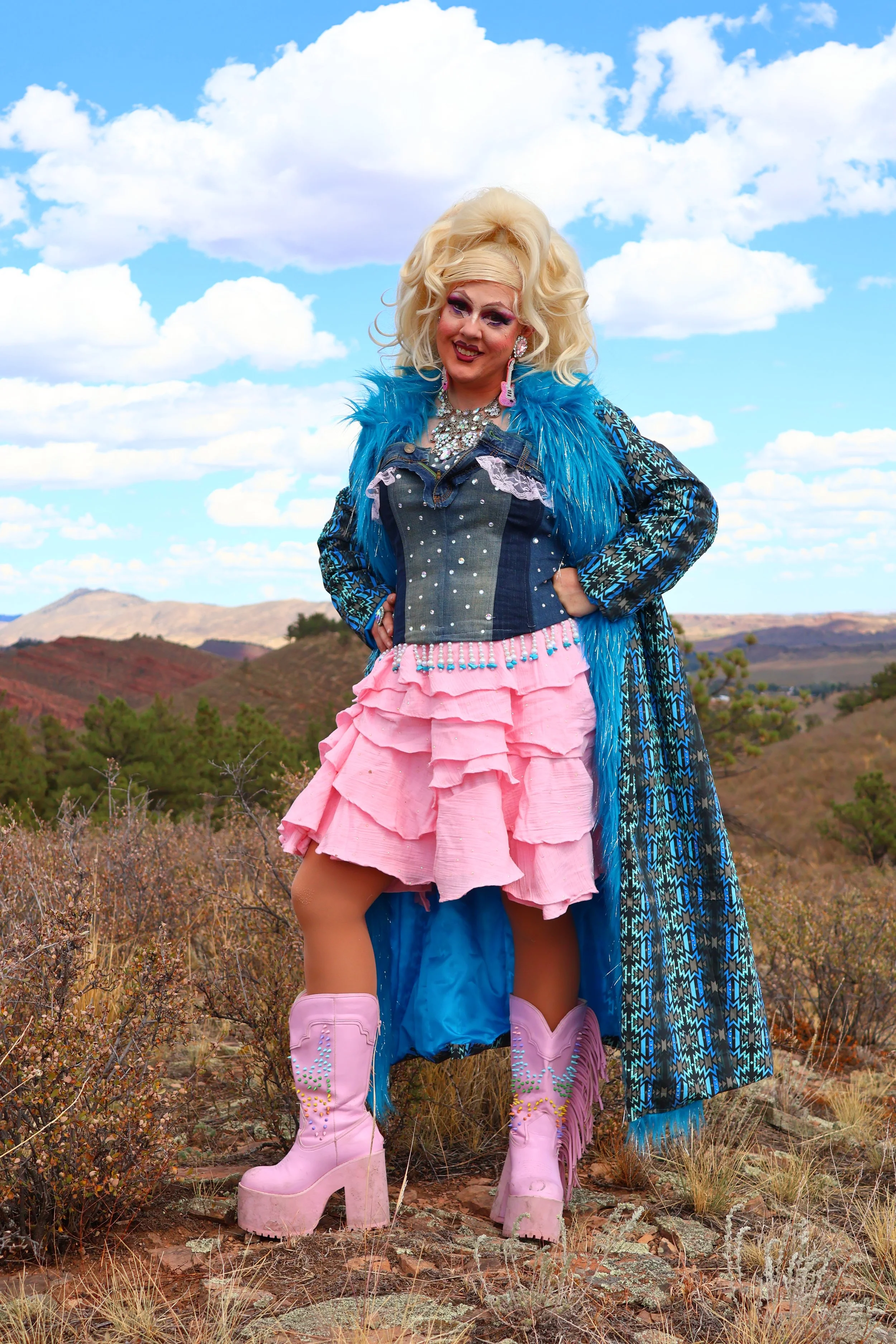
Tucked away in the Rocky Mountain foothills of Northern Colorado lies the home of the fabulously disgraced rodeo queen, Banna Meanshot, who brings an equestrian spin to the world of drag.
Raised in the heart of Colorado rodeo culture, Banna’s bond with horses spans over 30 years. Growing up, Banna’s father was a rodeo cowboy who introduced her to horsemanship through team roping with her siblings, learning to ride as a reward for helping. With a dream of becoming an Olympic Equestrian, Banna began English riding, citing that English is more welcoming to the queer community compared to Western riding.
As a college student during the 2008 financial crisis, the dwindling job market led her to train an Arabian stallion, ushering in her entrance to professional equestrianism. For years, Banna worked as a lower-level dressage rider with a passion for educating in horse training, which is apparent in her content.
“If you're a horse person, you listen to me, and you're like, this guy has done this professionally. Like, that is a man and a wig who has been here for years,” said Banna.
After the war in Ukraine began, Banna was forced out of the competitive equestrian industry and took a paralegal job because horse industry expenses skyrocketed, which catapulted her career in drag.
With Banna’s newfound free time, she took up sewing as a hobby, linking together clothes, stuffed animals, and quilts for her friends and colleagues. One night at a local drag show, Banna’s enlightenment occurred after she drew inspiration from the performance, deciding that she wanted to extend her artistry to drag.
“Part of doing drag and doing drag well is being something worth looking at for one reason or another. I’m thinking about what I bring to the table because I don't know how to do makeup, and I can't dance. But something that's always captivated people about me has been the way I talk about horses and the way I explain horses to people,” said Banna. “I wanted to have kind of a campy, funny take on this, and have my persona be this disgraced rodeo queen who's like, maybe, maybe been hit in the head a few times… is kind of goofy, but is also funny and, you know, is kind of a comic about rodeo culture. That is how I wanted to approach drag, through giving the audience a cartoon from the culture that raised me.”When constructing her drag persona, Banna wanted to honor her rodeo cowgirl upbringing, and drew inspiration from the horse medication, Banamine, only known as a deep cut within the equestrian community.
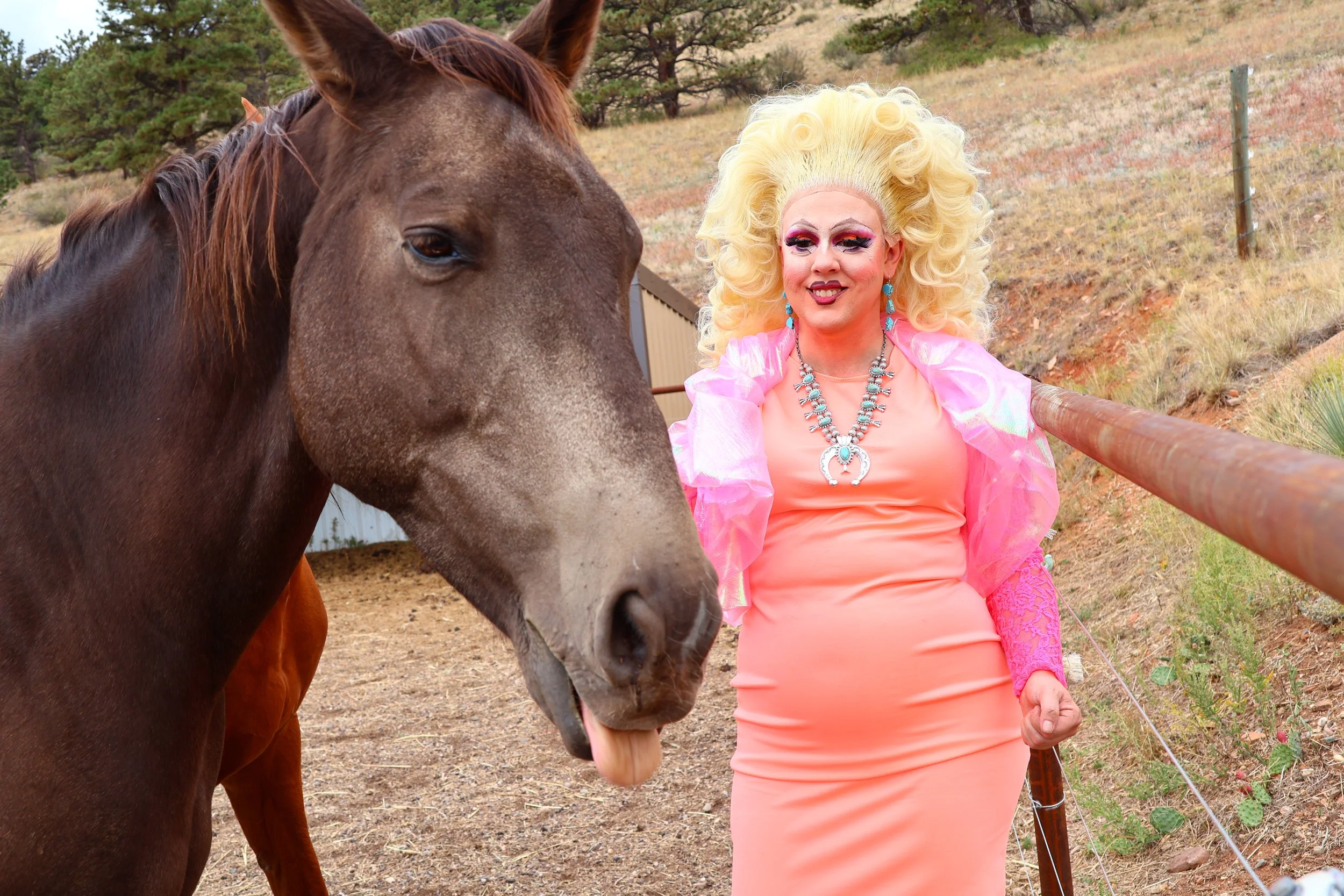
Tucked away in the Rocky Mountain foothills of Northern Colorado lies the home of the fabulously disgraced rodeo queen, Banna Meanshot, who brings an equestrian spin to the world of drag.
“I spent a lot of time wandering the aisles at the vet supply store when I was a child, and I would look up medication names because I had something wrong with me. I just imagined these different drug names as being characters in my head, and to me, the brand name for flunixin, Banamine, seemed like an elegant lady, and that kind of carried me forward to the modern day, where I'm like, what would be a good name for a disgraced rodeo queen who's like funny, but also a little bit unexpected,” said Banna. “Nobody knows what it means unless they're a horse person, and I'm kind of a little shit in that way, and I think that's the funniest thing ever. I picked the drag name that no one gets, but that's fine, I get to explain horse medications to people at the club at one in the morning.”
Equestrianism eventually became a hobby for Banna, and she is now a mother of two, Kaiser and Peppy, horses, that is. Located in the hills west of Loveland, Banna’s farm content frequently features Kaiser and Peppy, from horse bathing videos to rating indoor hitching spots, rope halter tying tutorials, and how to proactively examine your horse for colic, all while Banna is head to toe in full, washed-up rodeo royalty drag.
Before professionally joining the horse industry, Banna wrote novels for a living, but a horse kick to the head prevented her from continuing to write, later getting a cockroach tattoo on her arm saying “hard to kill,” because she put her arm over her head during the kick, an action that saved her life. Banna’s close call is among the many reasons she overemphasizes safe horse handling.
“I always wear a helmet when I ride, but not always when I'm handling the horse on the ground and sometimes, shit happens. So that's one of the reasons I'm passionate about getting people to understand, hey, this is not a game,” said Banna. On my content, I'm very much like, the horse is great, we get along with the horse all the time. In real life, I am a drill sergeant. I used to teach, and I was nice, but I was strict, and I made people learn the safety routines.”
Originally aimed at her surrounding drag community, Banna’s equestrian drag videos took the horse community by storm, diversifying the historically conservative equestrian crowd. “I'm obviously not making art for people who are fighting against my right to exist as a queer person. But at the same time, like, art is good for you. And, I know that art can bridge the gap between understandings, and some art has to do that,” said Banna. “I know my shit, and I've obviously been part of their community for a long time, and this is how I will express my queerness, thank you very much.”
As queer representation in the equestrian community is often scarce, Banna’s content showcases the vibrant reality of the horse community, and that horse ownership isn’t just reserved for white, affluent, and cisgender people.
“On the internet, I stick to equestrian topics, and my goals are: One, I don't think keeping horses is inherently evil, and it doesn't have to be. I take great care of my horses, and they live comfortable lives, and I want to show a lot of queer people that these horses don't live in a box where they never see the sun,” said Banna. “That's possible on a modest budget, and it's something people do. Two, I want to show people in the equestrian community [that] queer people are here. They are competent members of your community.”
On stage, Banna’s drag performances use more flamboyant and politically driven elements compared to her content online, because in a gay bar, “you’re preaching to the choir.”
“I go on stage as the Virgin Mary, and I'm pregnant, and I get an abortion on stage, and it's a bread loaf that is made to look like a fetus. I'm not lying, I have it up on my TikTok,” said Banna. “I do the abortion number, and I do it to a couple of country songs, and it's one of my favorite numbers. It's really unhinged, and I'm not afraid to look at that part of the culture behind country music.”
In her North Colorado community, Banna is creating the amateur drag opportunities she yearned for as a college student, as North Colorado is bustling with college towns. Banna deeply considers and uplifts professional drag queens by facilitating amateur drag not to take up space from the professional drag queens who rely on the income they make from performances amid intensified housing and employment crises in the queer and trans community.
“The fact is, drag is expensive, and people with my degree of economic privilege, who are doing drag, are few and far between because we have employment discrimination in this community. We have housing discrimination in this community, and an invisible tax on queer and trans people,” said Banna. “That's the raw reality of why I do what I do. My services are required here. I need to be putting in some volunteer hours to create these amateur spaces because the dolls are not being employed. As someone who is not a doll, I need to be picking up the economic slack with the privileges afforded to me.”
Since 2025, Banna has hosted open stages in Fort Collins and Greeley, including her open stage titled “Sanctuary” at the Foothills Unitarian Church. Banna began working with Foothills Unitarian in 2024, when she auditioned for “A Drag Christmas Spectacular,” playing the homophobic mother, and was asked to host the first installment of “Sanctuary” in 2025.
“I wanted (Sanctuary) to have this dual purpose because it is a safe space for art and queerness, but it's also very much in a church. I wanted there to be an expectation up front like, hey, we're doing the show in the church. I'm not going to shy away from that,” said Banna. “This is a space associated with religion. But it's also your safe space to do whatever kind of art you want. Doing this art in the church, making it a safe space for art and for queerness has been a really fulfilling project and something the Unitarians are uniquely poised to do.” Banna’s open stage invites anyone interested in performing in drag with no expectations, regardless of experience, reinforcing that drag is for everyone. After all, we’re all born naked, and the rest is drag! (RuPaul).
“It's fun, and people love the community it creates, and people love seeing local art that has heart, and that has been planned by one of their friends. It's art that counts, and it's art that says something. A lot of the time it's sometimes weird, sometimes it's off-putting. But if you're not bringing something weird and off-putting to the open stage, where are you going to bring it,” said Banna. “Part of developing as an artist is having somewhere to put your art that isn't super polished and being less afraid. If my open stages help people be less afraid to make their art, then that is awesome. So sign up for my open stage. If you've ever thought about drag before, come to my open stage, it’s a great time.”
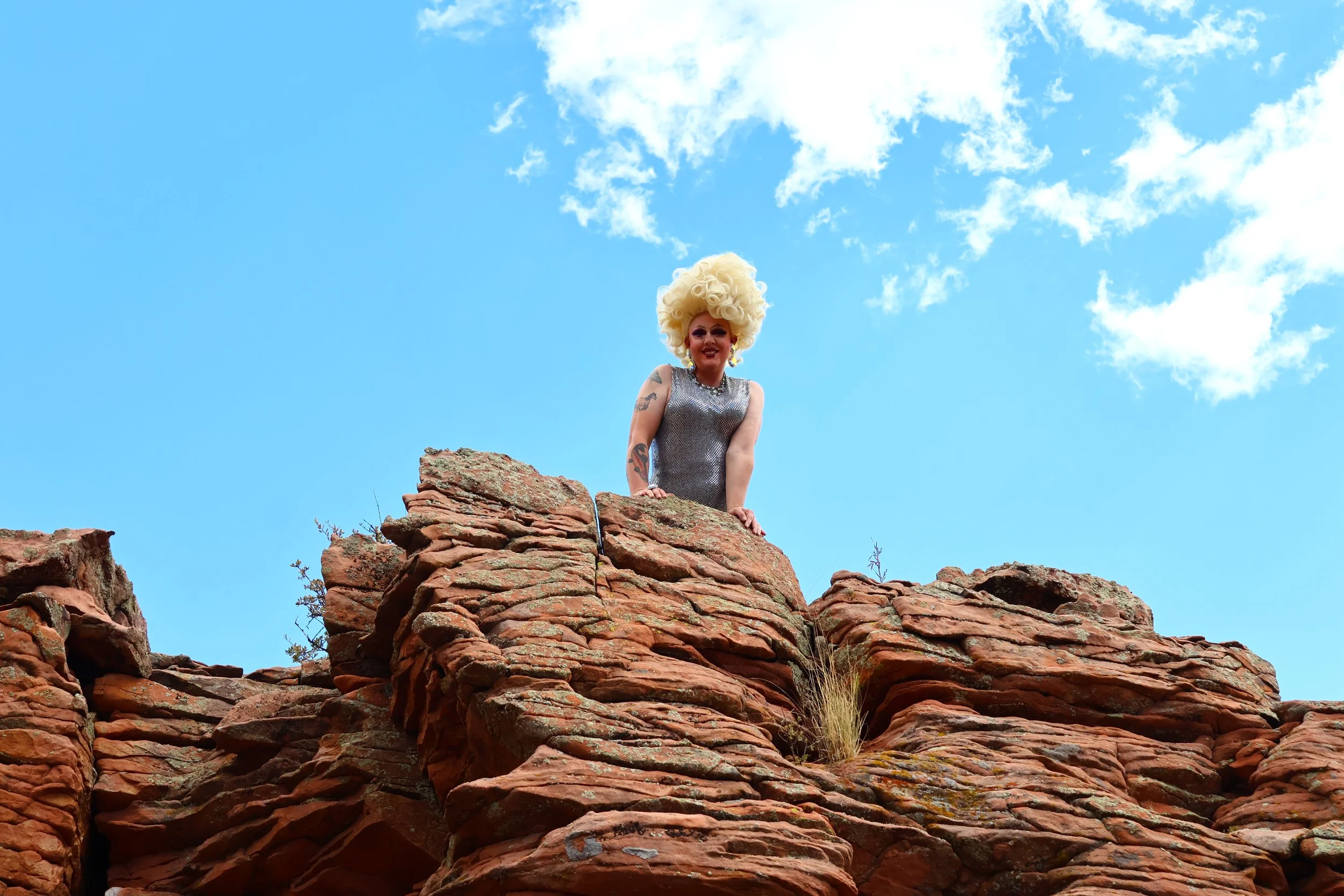
PHOTOS BY: PHOTOGRAPHYBYFOREST (INSTAGRAM)
Banna has curated her drag as a foundation of empowerment and support for younger queens in search of a welcoming space to confidently express their artistry, and to depend on one another for guidance.
“I have a drag child, MidDay V Thorn, who is also very fierce and who I adopted because they were taking public transportation from Fort Collins to Colorado Springs. I'm like, I'm going to take you in my car instead. We have this bond; I can help you out, and I can give you rides, and help you develop your drag, so we became drag family,” said Banna. “That generational kind of thing is very much why I like doing drag and, you know, it gives me good feelings that people can organize because people joining together as a community is always in their best interest.”
Most of our day-to-day activities don’t often afford us the luxury of expressing ourselves, free of expectations. Exuding an air of confidence and independence, Banna credits drag with freeing her from the constraints of professionalism in her day job and the responsibility of caring for her horses.
“Horses require a lot of emotional restraint, and a lot of emotional control. You have to be very self-aware and very calm around horses, and that takes a lot of emotional wherewithal. I have a lot of things I'm not able to express about life when I'm with my horses,” said Banna. “Obviously, being in law, a very buttoned-down field, we're very focused on business at my workplace, and that's not the place to be creative. Being able to do art for pleasure and self-expression is so valuable to me, and that's why I put the hours I do into drag.”
Banna’s open stage performances inspire us to unleash our inner horse girl and beg us to ask ourselves what life can look like when we become the most authentic version of ourselves and truly free.
If you’re interested in indulging your inner wild horse and developing your drag persona, contact Banna via email, or attend Banna’s upcoming open stage on November 16th at Foothills Unitarian Church and December 9th at Stampede Kava.
Stay up to date with Banna via Instagram and TikTok. —
Thank you for reading! Stay connected with staff writer Leah Korenberg via her Instagram.